
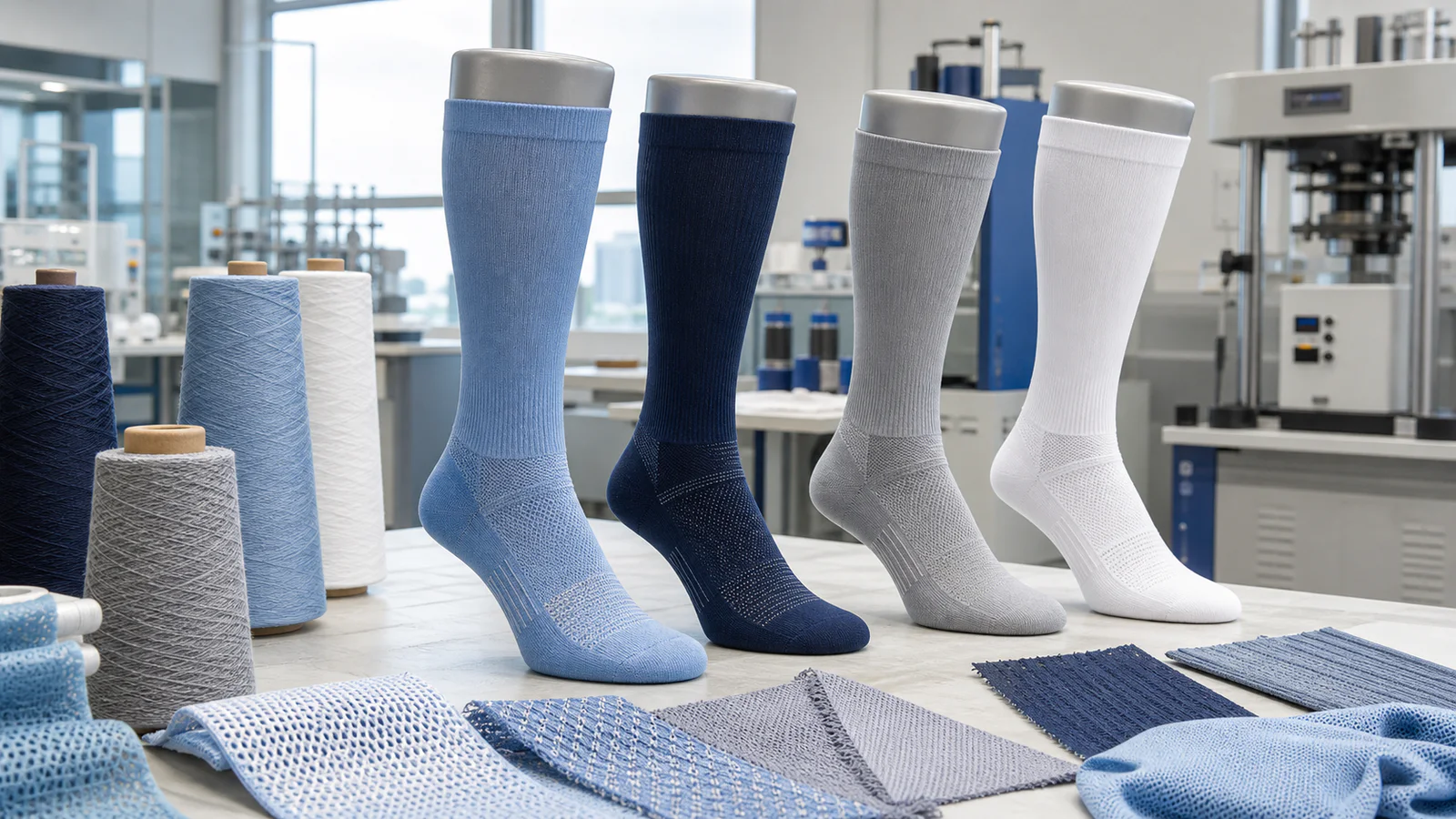
Quick answer
A credible cooling compression sock combines an appropriate yarn system with low-bulk knitting, breathable zones, moisture transport, drying performance, and a pressure profile that remains stable after laundering. Buyers should define whether cooling means an initial cool touch, lower thermal resistance, better sweat transport, faster drying, or a combination, then compare the finished sock with a control under declared test conditions.
Cooling compression socks are a useful product direction for hot climates, summer travel, healthcare shifts, office wear, sports, and customers who dislike the warm feel of dense hosiery. However, the word cooling is not a complete technical specification. A yarn can feel cool for the first few seconds while the finished sock still traps moisture or dries slowly.
Define what cooling means before sampling
Start the RFQ with the wearer problem and the evidence needed for the sales claim. Initial contact cooling, moisture movement, drying rate, air permeability, thermal resistance, and water-vapour resistance describe different aspects of comfort. They should not be treated as interchangeable results.
| Buyer objective | Development direction | Useful evidence |
|---|---|---|
| Cool feeling at first touch | Yarn and fabric with higher contact heat transfer, smooth surface, controlled thickness | Initial contact cooling or Q-max result using an agreed method and control |
| Move perspiration away from skin | Capillary yarn geometry, hydrophilic treatment, mapped knit structure | Liquid moisture-management and wicking results |
| Dry faster after sweating or washing | Lower water retention, exposed surface area, lower-bulk construction | Drying-time comparison at the same conditioning and water load |
| Reduce a hot, enclosed feeling | Breathable mesh zones and controlled fabric density | Air permeability plus thermal and water-vapour resistance data |
| Maintain compression performance | Compatible elastic yarn, dimensions, heat setting, and size grading | Pressure, stretch, recovery, and wash-retention results on finished socks |
Cooling comes from the complete sock system
A cooling additive or branded yarn cannot guarantee the performance of a knee-high compression sock. Fiber blend, yarn count, filament shape, knit density, elastane coverage, color, cushioning, mesh placement, boarding, and garment fit all change heat and moisture behavior. Tight compression zones can also reduce openness compared with a non-compression fabric made from the same yarn.
Ask suppliers to develop and test the finished construction rather than submitting only a yarn certificate or a flat swatch result. A swatch can be helpful for screening, but the production sock is the item worn, washed, packaged, and sold.
Material directions for a cooling brief
- Moisture-management polyester: engineered filament shapes or finishes can support capillary movement and relatively fast drying.
- Fine-denier nylon or polyamide: can provide a smooth hand, durability, and a lighter construction when the knit is properly balanced.
- Regenerated cellulosic blends: can support softness and moisture absorption, but absorption alone does not prove fast drying or a lasting cooling effect.
- Functional mineral or ceramic additives: may change contact or thermal behavior, but the buyer should request traceability, dosage consistency, safety documentation, and finished-product test data.
- Elastane and covered elastic: remain essential to pressure and recovery. Cooling yarn cannot replace compression engineering.
Use breathable zones without weakening the product
Mesh can be placed at the instep, upper calf, or other lower-risk zones, while the ankle and pressure-control areas retain the density needed for the target profile. A thinner sole may feel cooler in close footwear, while targeted cushioning may be more appropriate for running or long standing. The design team should review abrasion, snagging, opacity, and pressure continuity whenever a mesh zone changes.
Build a test plan around the claim
AATCC TM195 measures and classifies liquid moisture-management properties of textile fabrics. Related AATCC methods can assess wicking and drying behavior. ISO 11092:2026 measures thermal resistance and water-vapour resistance under steady-state conditions with a sweating guarded-hotplate. The ISO scope also makes clear that its laboratory conditions are not themselves a specific comfort situation.
If the brief includes an initial cool-touch claim, agree on the Q-max or other contact-cooling method, specimen conditioning, test side, contact temperature difference, repetitions, and control fabric before sampling. Results from different laboratories or conditions should not be compared as if they are identical.
Compare against a meaningful control
Request a standard compression sock in the same pressure range, size, color direction, and approximate weight as the control. Then compare the cooling version after production-equivalent dyeing, finishing, boarding, and repeated laundering. A lighter sock should not be declared superior solely because it contains less material; the test plan should show which construction change created the benefit.
Compression, fit, and wearer trials still matter
A cooling product that slides, wrinkles, binds at the cuff, or loses pressure will not succeed. Approve ankle, calf, foot, and leg dimensions for every size. Conduct wear trials in the intended footwear and climate with several body measurements. Record thermal sensation, dampness, drying perception, cuff security, seam comfort, and ease of application separately.
Avoid claims that exceed the evidence
Cool touch, moisture wicking, breathable, and quick drying are different claims. A short contact-cooling result does not prove that a sock keeps skin a fixed number of degrees cooler for an entire shift. Avoid permanent cooling, clinically proven, antibacterial, or medical-benefit wording unless the exact finished product and claim have suitable evidence and target-market review.
What to include in the RFQ
- Target wearer, climate, footwear, price point, pressure range, and size system.
- Required cooling mechanism and the exact claim planned for packaging.
- Preferred fiber direction, color palette, cushioning, mesh zones, toe style, and cuff structure.
- Test methods, control sample, pass criteria, wash cycles, and approved laboratory.
- MOQ by color and size, sample stages, packaging, lead time, and bulk inspection plan.
Buyer takeaway
The strongest cooling compression sock program starts with a measurable comfort problem, not a fashionable yarn name. Develop the yarn, knit, pressure, fit, and finish as one system; compare the final sock with a fair control; and write claims that match the available evidence.
Frequently asked questions
Which fabric is best for cooling compression socks?
There is no universal best fiber. A suitable product often combines moisture-management nylon or polyester, elastane, a lower-bulk knit, and targeted breathable zones. Compare finished-sock results rather than choosing by fiber name alone.
Does a cool-touch test prove all-day cooling?
No. An initial contact-cooling result describes the first heat-transfer sensation under defined conditions. All-day comfort also depends on moisture transport, drying, thermal and water-vapour resistance, fit, activity, climate, and footwear.
Can cooling performance survive repeated washing?
It may, depending on whether the effect comes from the polymer, yarn geometry, finish, or knit construction. Buyers should repeat the relevant performance tests after the agreed wash cycles and approve care instructions accordingly.