
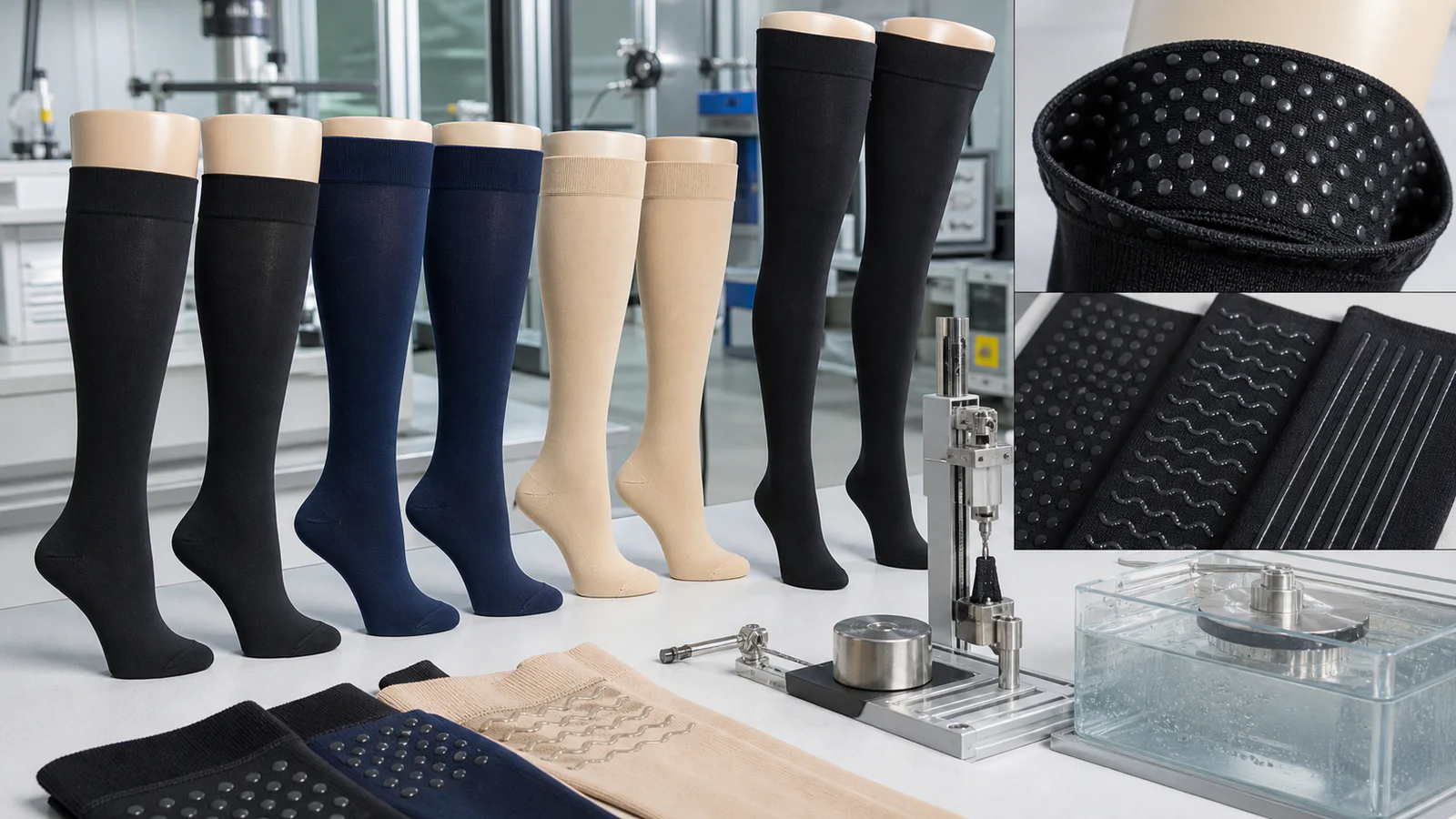
Quick answer
Silicone grip dots are cured elastomer deposits applied to the inside of a compression sock or stocking top band to increase friction against the skin and reduce downward movement. A successful grip top needs the correct cuff dimensions and pressure first, followed by controlled silicone chemistry, dot geometry, placement, cure, adhesion, wash durability, and wearer testing. More silicone is not automatically better.
Buyers sometimes describe this construction as glue dots at the sock opening. In production, the functional material is usually a deposited and cured silicone elastomer rather than a permanently sticky glue. The distinction matters because the grip must flex, recover, survive washing, and contact skin without uncontrolled tack, transfer, or residue.
Where is a silicone grip top used?
Grip bands are common on thigh-high compression stockings, sleeves, and products that have more surface area available to slide. Some brands also request dots inside over-the-calf or knee-high cuffs for work, sport, or special fit requirements. A standard knee-high sock often stays up through its knitted cuff and correct sizing alone, so the manufacturer should confirm that silicone adds a real benefit for the intended style.
Grip is an addition to fit, not a replacement for fit
A loose sock can still move even with silicone, while an undersized cuff can feel restrictive, roll, or mark the skin. Set the ankle, calf, top-opening, leg-length, and stretch measurements for each size before optimizing the grip pattern. Review cuff pressure and slippage together during wear trials.
| Grip format | Development advantage | Points to control |
|---|---|---|
| Small silicone dots | Flexible coverage and adjustable spacing | Dot diameter, height, pitch, count, missing dots, and edge clearance |
| Wavy silicone lines | Continuous grip with stretch-friendly geometry | Line width, spacing, breaks, cure, and extension behavior |
| Parallel silicone stripes | Simple repeatable placement | Stripe width, number, alignment, and cuff distortion |
| Continuous silicone band | High contact area | Heat and moisture buildup, edge lift, tack, stiffness, and wearer tolerance |
| Silicone-free textured cuff | Alternative for customers avoiding silicone | Knitted friction, cuff pressure, recovery, and actual slippage performance |
Write the dot pattern as a measurable specification
A photo is not enough for bulk production. State the number of rows, dot diameter, dot height, center-to-center spacing, silicone coverage area, distance from the cuff edge, pattern repeat, color, and target deposit weight or an equivalent production control. Keep enough clear textile between deposits so the cuff can extend without creating a rigid sheet.
The pattern should remain inside the garment when worn and should not leak over the cuff edge. Ask for a flat technical drawing and a sealed physical sample. For multiple sizes, confirm whether the pattern count, spacing, or overall coverage changes with circumference.
Control the silicone material and curing process
Request the silicone supplier, product reference, technical data, safety documentation, mix ratio where relevant, storage limits, curing conditions, and change-control procedure. The factory should monitor viscosity, dispensing consistency, temperature, time, and full cure. An under-cured material may remain excessively tacky or transfer; an overbuilt deposit may crack, feel hard, or restrict stretch.
If a supplier changes the silicone, pigment, catalyst, application equipment, curing conditions, or cuff substrate, require reapproval. A material that performs on one textile may bond differently to another finish or fiber blend.
Skin-contact documentation and responsible claims
The grip area has direct and often prolonged skin contact. Ask for applicable chemical and harmful-substance documentation for both the textile and silicone component, then confirm that the submitted material matches bulk production. OEKO-TEX STANDARD 100 evaluates textiles and accessory materials for harmful substances, with stricter requirements as skin contact becomes more intensive. A brand should only use the certification label when the actual article and components are covered by a valid certificate.
Do not automatically describe the product as hypoallergenic, allergy-free, irritation-free, or medical grade. Some wearers may be sensitive to silicone, pressure, perspiration, finishes, or friction. Claims and required warnings depend on the destination market and intended product classification.
Prototype tests for a grip-top sock
- Visual inspection: pattern position, missing or merged dots, bubbles, contamination, color, and edge clearance.
- Stretch and recovery: cuff extension with the silicone in place, followed by recovery and inspection for cracking or delamination.
- Adhesion and rub: screen for lifting, peeling, transfer, flaking, or surface damage under an agreed method.
- Wash durability: repeat visual, adhesion, stretch, tack, and slippage checks after the labeled care cycles.
- Wear trials: record slippage, rolling, pressure sensation, red marks, perspiration, hair pulling, and ease of removal across the size range.
- Compatibility: check that lotions, oils, powders, or normal skin moisture do not create an unexpected loss of grip or residue under the defined use conditions.
Balance grip, comfort, and breathability
Increasing silicone coverage can improve dry friction but may also reduce flexibility and moisture escape. Large deposits can create pressure points, while very small or widely spaced dots may provide little benefit. The best pattern is the smallest effective coverage that meets the slippage target without compromising comfort, stretch, or washing.
Bulk quality-control checklist
Define an approved reference sample and inspection limits for placement, pattern dimensions, deposit appearance, adhesion, stretch, cure, tack, odor, staining, and contamination. Use a repeatable sample plan by size and production lot. Inspect products after boarding and packaging because heat, pressure, and prolonged contact can affect the silicone surface.
Care instructions and packaging
Silicone grip usually performs best when the contact area is clean. Oils, creams, fabric softener, excessive heat, and unsuitable drying can reduce grip or damage the product, depending on the construction. Validate the exact care method on production-equivalent samples and print concise instructions that match the test program.
Packaging copy should identify the grip feature without implying that it prevents every movement or skin reaction. Include the fiber composition, pressure range, size method, care, responsible use guidance, and any market-specific labeling required for the complete product.
What to send in the RFQ
- Product length, pressure range, cuff dimensions, size chart, and target wearer.
- Preferred dot, wave, stripe, or band pattern with measurable coverage.
- Silicone color, required material documents, restricted-substance requirements, and claim wording.
- Stretch, adhesion, washing, slippage, and wearer-trial acceptance criteria.
- MOQ by size and color, sample rounds, packaging, inspection level, and change-control rules.
Buyer takeaway
A silicone-dotted top can improve product stability when the cuff and size system are already correct. Specify the grip as an engineered component, approve it through wash and wear testing, and control the exact silicone, pattern, cure, and bulk inspection criteria.
Frequently asked questions
Do silicone dots stop compression socks from rolling down?
They can increase friction and reduce downward movement, but they do not correct an unsuitable size, leg length, cuff pressure, or garment shape. Rolling and slippage should be evaluated separately in multi-size wear trials.
Are silicone grip dots safe for every wearer?
No material should be presented as suitable for every person. Request appropriate skin-contact and harmful-substance documentation, avoid unsupported hypoallergenic claims, and offer a silicone-free option when the target customer requires one.
Are silicone dots better than a continuous grip band?
Neither is universally better. Dots usually preserve more stretch and open area, while a continuous band provides more contact. Compare slippage, comfort, moisture, stretch, adhesion, and wash durability on the final construction.