
Quick answer
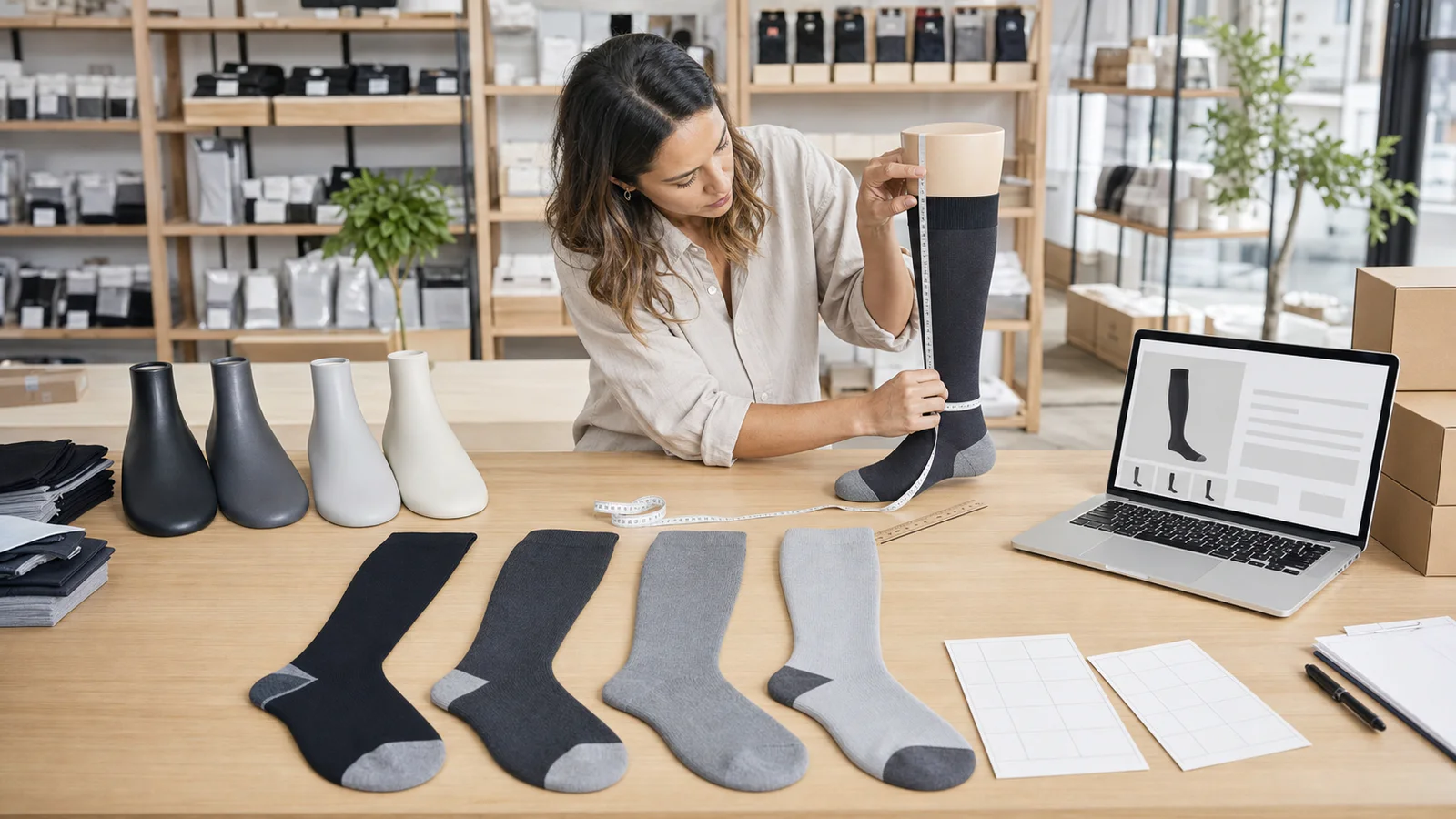
Compression sock ecommerce sizing should lead with ankle and calf measurements, add foot or shoe reference and leg length when relevant, explain how to measure, and show what to do between sizes. Brands can reduce avoidable returns by aligning the chart with the actual product, repeating the same guidance on packaging, tracking return reasons by size, and revising unclear content.
A factory size code is not automatically a customer size guide. Ecommerce content must translate garment measurements and intended body measurements into a simple choice customers can make without touching the product.
Build the chart from the product
| Information | Why it matters | Where to show it |
|---|---|---|
| Ankle circumference | Core input for many knee-high compression constructions | Chart and measuring diagram |
| Calf circumference | Helps prevent excessive tightness or loose fit | Chart, product page, and packaging |
| Foot or shoe reference | Supports heel and toe placement | Secondary chart column |
| Leg length | Reduces cuff sitting too high or too low | Guide when relevant to the style |
| Between-size rule | Removes a common purchase hesitation | Directly below the chart |
Use customer language
Show exactly where to place the tape, the unit of measurement, and whether the value is body circumference or garment size. Keep inches and centimeters clearly separated. Avoid relying on S, M, and L without numeric ranges.
Make mobile sizing usable
Many buyers view the chart on a phone. Use a responsive table, short measurement steps, readable labels, and an image that does not require zooming. Put the chart near the size selector rather than hiding it in a footer or FAQ.
Align every customer touchpoint
The product page, marketplace listing, package, insert, and customer-service script should use the same size ranges and between-size rule. Version-control the chart so old artwork does not remain in circulation after a product change.
Learn from return reasons
Track too tight at calf, loose at ankle, foot too long, heel misplaced, cuff too high, difficult to put on, and expectation mismatch as separate reasons. Review by product, size, and channel. A spike can reveal a chart problem, a construction change, or misleading product copy.
Buyer takeaway
A strong size chart is part product specification, part interface design, and part quality feedback system. Connect it to actual measurements, make it easy to use on mobile, and use return data to improve both content and future size grading.
Frequently asked questions
Is shoe size enough for compression socks?
Shoe size can help with foot length, but ankle and calf measurements are usually more useful for selecting a knee-high compression fit. Leg length may also matter.
What should a between-size rule say?
It should give a clear decision based on the measurement most important to the product, while directing customers with medical concerns or unusual fit needs to appropriate advice.
How often should a size chart be reviewed?
Review it after construction or supplier changes and at regular intervals using return reasons, exchanges, customer questions, and fit-test results.