
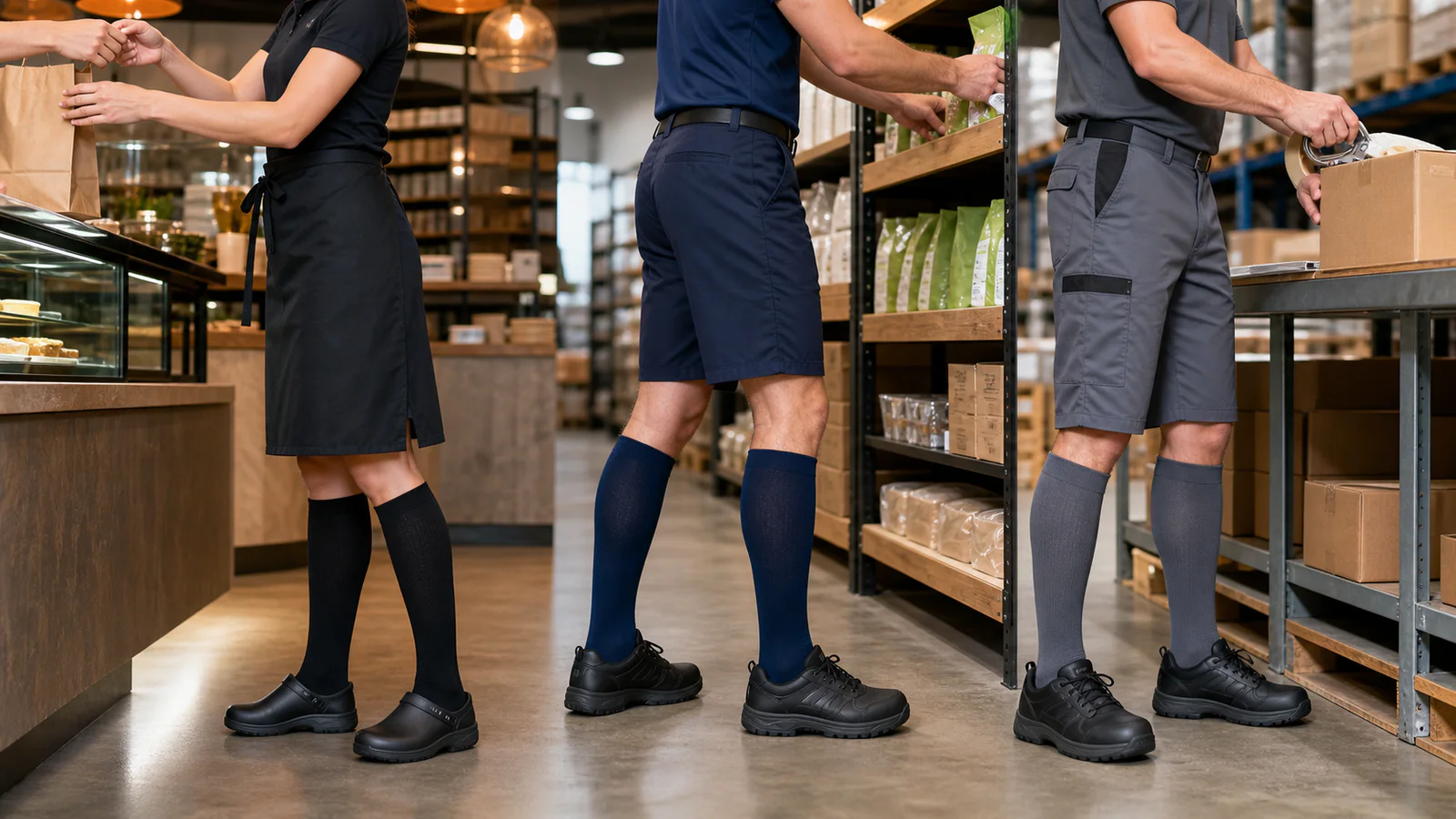
Quick answer
A standing-all-day workwear compression sock program should prioritize secure fit, cuff comfort, breathable construction, smooth toe and heel placement, work-shoe compatibility, conservative core colors, clear ankle-and-calf sizing, and repeat-wash durability. Product briefs should reflect the actual job, climate, footwear, uniform rules, and purchasing channel.
Retail, hospitality, warehouse, salon, teaching, security, and service roles all involve standing, but their footwear, temperature, dress code, and movement patterns differ. Avoid treating occupational compression socks as one universal specification.
Match product direction to the workplace
| Work setting | Likely priorities | Sample check |
|---|---|---|
| Retail and hospitality | Dress colors, low bulk, smooth appearance, all-day comfort | Loafers, service shoes, standing and walking |
| Warehouse and logistics | Durability, moisture, reinforced foot, stable cuff | Work shoes, heat, abrasion, repeated movement |
| Salon and service | Comfort, style, easy care, color choice | Long standing periods and uniform match |
| Employer uniform program | Simple sizing, reliable replenishment, name-free packaging | Assortment ratio, issue process, repeat order consistency |
Design around the shoe
Foot thickness, toe construction, heel placement, and cushioning determine whether the sock works with a required shoe. Test with the narrowest and heaviest footwear in the program. A durable work sock can still fail if it creates bulk or bunching.
Keep the cuff stable without overbuilding it
Evaluate slippage, rolling, visible marks, and recovery after hours of use. The top band should be approved as part of the full pressure and size construction, not treated as a decorative finish.
Choose colors for replenishment
Black, navy, charcoal, and neutral tones support uniform programs and repeat orders. Add patterns or accent colors only where the channel values them. Fewer core combinations make it easier to keep the right sizes available.
Use workday wear tests
Short fitting sessions will not reveal every issue. Ask participants to record footwear, shift duration, temperature, slippage, cuff feel, toe comfort, moisture, and ease of removal. Review results by size rather than averaging all wearers together.
Buyer takeaway
Start with a clearly defined worker group. Align product construction with footwear, climate, uniform and care routines, then build a simple core range that employers and retailers can replenish reliably.
Frequently asked questions
Which colors are best for workwear compression socks?
Black, navy, charcoal, and other uniform-compatible colors are dependable core choices. Channel-specific accents can be added after the base range is established.
How should employers choose a size assortment?
Collect relevant ankle, calf, foot, and workforce data where appropriate, then plan the ratio from actual measurements instead of a generic apparel curve.
Can one workwear sock serve every occupation?
Not ideally. Footwear, heat, movement, dress rules, wash frequency, and durability needs vary, so buyers should define the target role before finalizing construction.