
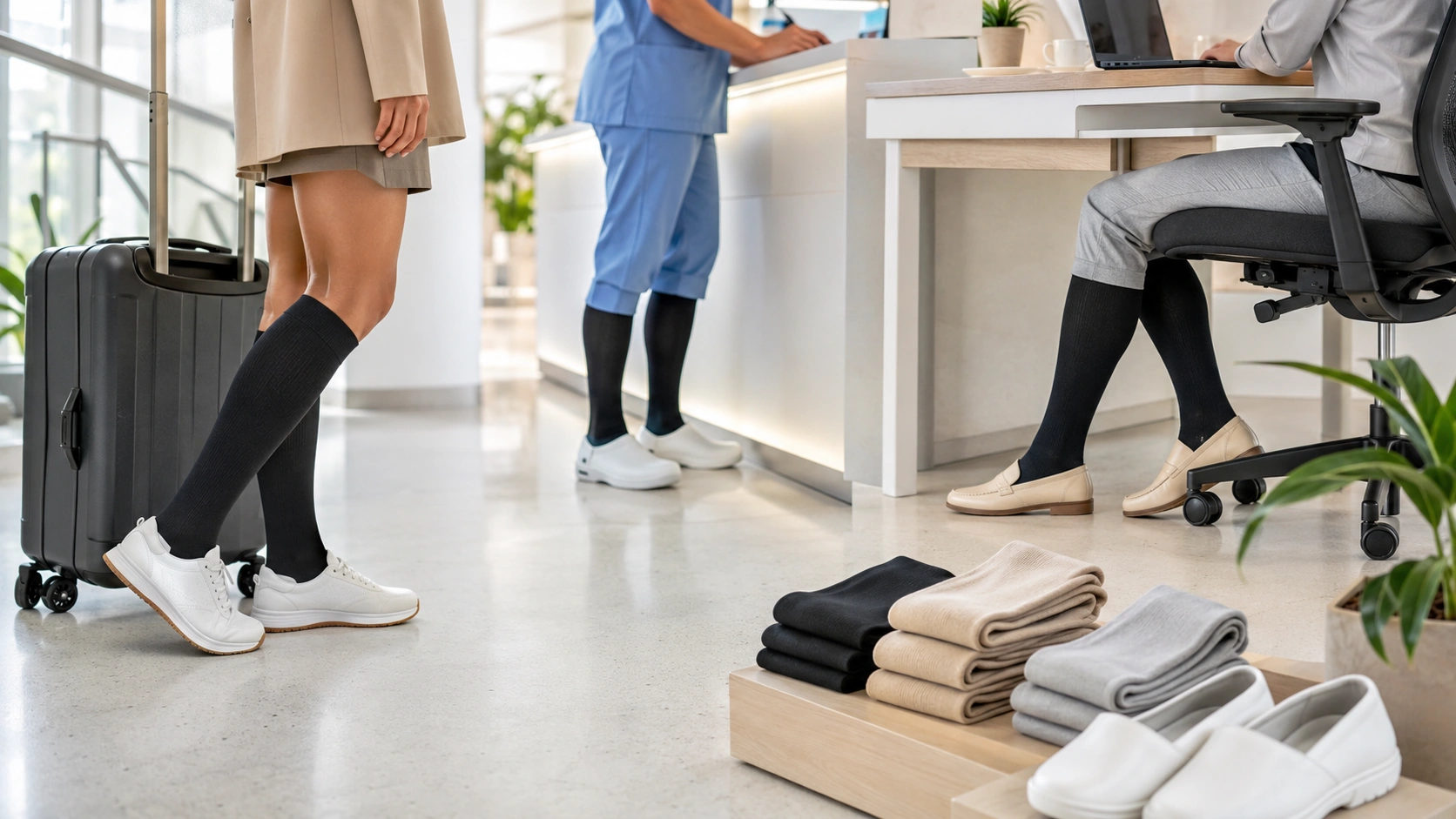
Compression socks are often purchased for situations where people sit, stand, walk, or work for long periods. For B2B buyers, the opportunity is broad: travel accessories, nurse uniform programs, workwear supply, wellness kits, office comfort, and online multi-pack retail.
The key is to match product details with real user expectations. A nurse working a long shift, a frequent traveler, and an office worker may all want comfort, but they may respond to different materials, colors, packaging, and product copy.
Travel compression socks
Travel buyers often want socks that feel comfortable during long flights, train trips, and road travel. The product should be easy to pack, easy to understand, and comfortable enough for first-time users. Neutral colors such as black, navy, grey, and beige are common, while giftable or pouch packaging can support travel retail.
- Compact packaging for luggage and retail display.
- Clear sizing for international buyers and online stores.
- Soft cuff and breathable yarn direction for long wear.
- Simple product copy focused on comfort and support.
Nurse and healthcare work socks
Nurses and healthcare workers often stand and walk for long shifts. For this channel, product comfort needs to be practical, not decorative only. Buyers should review stay-up cuff performance, toe seam feel, heel durability, calf fit, and wash performance.
Packaging for nurse-focused products should speak clearly to long-shift comfort, easy care, and size selection. Conservative solid colors may work for uniform settings, while brighter options can work for online lifestyle brands.
Standing-all-day work categories
Retail workers, warehouse teams, hospitality staff, baristas, teachers, and salon professionals can all be target users for work-oriented compression socks. For these buyers, everyday durability and comfort matter more than complex product claims.
- Reinforced heel and toe for stronger durability perception.
- Stay-up cuff that does not roll down easily.
- Breathable material direction for long hours.
- Practical colors that match uniforms or workwear.
Office and everyday wellness buyers
Office workers and everyday wellness consumers may prefer a softer entry-level product. These buyers often care about comfort, simple styling, and ease of wearing. Our in-stock socks are 10-20 mmHg, while 20-30 mmHg can be discussed for custom stronger-support programs.
For everyday retail, the product should not look overly medical unless that is the intended channel. Clean packaging, neutral colors, and easy size guidance can make the category more approachable.
Sports and recovery positioning
Sports and recovery buyers may look for breathable fabric, secure fit, and performance styling. Color options can be more energetic, and product photography often matters more. However, comfort and fit remain essential. A sock that looks athletic but slips down or feels too tight will not support repeat purchase.
For this channel, buyers should consider whether the product will be sold as knee-high compression socks, calf sleeves, recovery socks, or travel-and-sport crossover items.
How to reduce fit complaints
Fit complaints are one of the biggest risks in compression sock retail. Buyers can reduce this risk by preparing a detailed size chart, explaining how the sock should feel, offering wide-calf options where needed, and testing samples on different leg shapes.
Online buyers should also prepare FAQ content and product images that explain size selection. A good product page can prevent confusion before purchase.
Build the product around the use case
The strongest compression sock programs are not generic. They are built around a clear use case, a defined wearer, and a realistic retail promise. When the product, packaging, and product copy all support the same buyer need, the program becomes easier to sell and easier to reorder.