
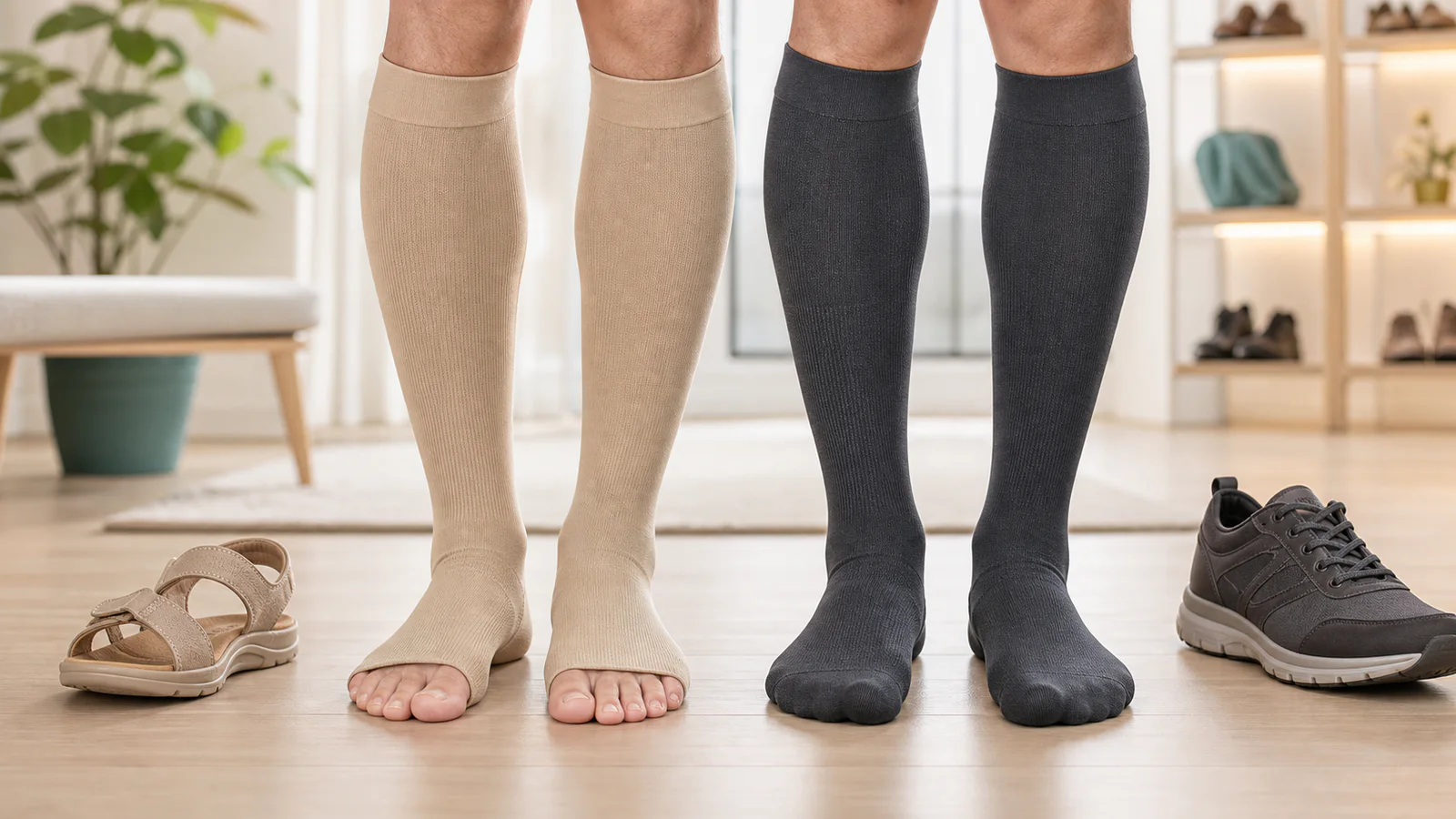
Quick answer
Open-toe compression socks leave the toes uncovered and can suit customers who prefer ventilation, flexible toe fit, or their own socks over the foot. Closed-toe styles provide full-foot coverage and a familiar all-in-one wearing experience. Neither is universally better.
Toe construction changes comfort, footwear compatibility, finishing, and customer expectations. B2B buyers should choose it by target user and channel rather than treating open toe as a premium upgrade or closed toe as the only standard option.
Quick buyer comparison
| Decision point | Open toe | Closed toe |
|---|---|---|
| Coverage | Toes remain uncovered | Full foot and toe coverage |
| Footwear | Can work with sandals or a separate sock, depending on design | Simple with closed shoes and boots |
| Toe fit | Less dependent on toe length and toe-box shape | Requires careful foot and toe dimensions |
| Construction focus | Opening finish, edge comfort, and position | Toe seam, toe room, heel alignment, and reinforcement |
When open-toe styles make sense
Open-toe products can suit warm climates, customers who dislike toe pressure, and channels where sandals or flexible footwear are common. They may also appeal to customers who prefer to wear a separate thin sock over the foot area.
The opening needs a smooth, stable finish. Buyers should review whether it stays in position, feels comfortable across different foot widths, and remains consistent after washing.
When closed-toe styles make sense
Closed-toe compression socks are familiar, easy to merchandise, and practical for travel, nursing, workwear, office, and everyday footwear. The product offers a complete sock in one piece and can include a reinforced heel and toe.
Sample review should focus on toe seam feel, toe room, foot length, heel placement, and how the sock behaves inside shoes. A regular-calf product still needs correct foot grading across sizes.
Merchandising and packaging
Show the toe construction clearly in product photography. An open-toe product can be returned if a customer expects a normal sock, while a closed-toe product can disappoint someone specifically looking for uncovered toes. Put the feature in the product title, front-panel callout, diagrams, and online images.
Consider offering both as a line extension
Brands serving pharmacies, wellness stores, or broad online audiences may offer both constructions in the same visual identity. Keep size-chart logic, colors, packaging hierarchy, and claims consistent so customers can compare without confusion.
Sample checklist
- Opening edge or toe seam comfort.
- Foot length, heel alignment, and calf fit.
- Wear inside the target footwear.
- Position after walking and extended wear.
- Appearance and recovery after washing.
Buyer takeaway
Open toe supports preference and flexibility; closed toe supports familiarity and full-foot coverage. Choose through wearer research and sample testing, then make the construction unmistakable in every sales image and package.
Frequently asked questions
Are open-toe compression socks stronger than closed-toe socks?
Toe construction does not by itself determine the pressure range. Buyers should compare the labeled range, construction, sizing, and supporting test plan.
Which style is easier to sell online?
Closed toe is familiar to many shoppers, but open toe can serve a clear preference. Accurate titles, photos, and size guidance matter more than choosing one format for every audience.
Can open-toe compression socks be private labeled?
Yes. Open-toe programs can discuss pressure direction, regular-fit sizing, colors, logo, packaging, and opening construction based on the project brief.