
Quick answer
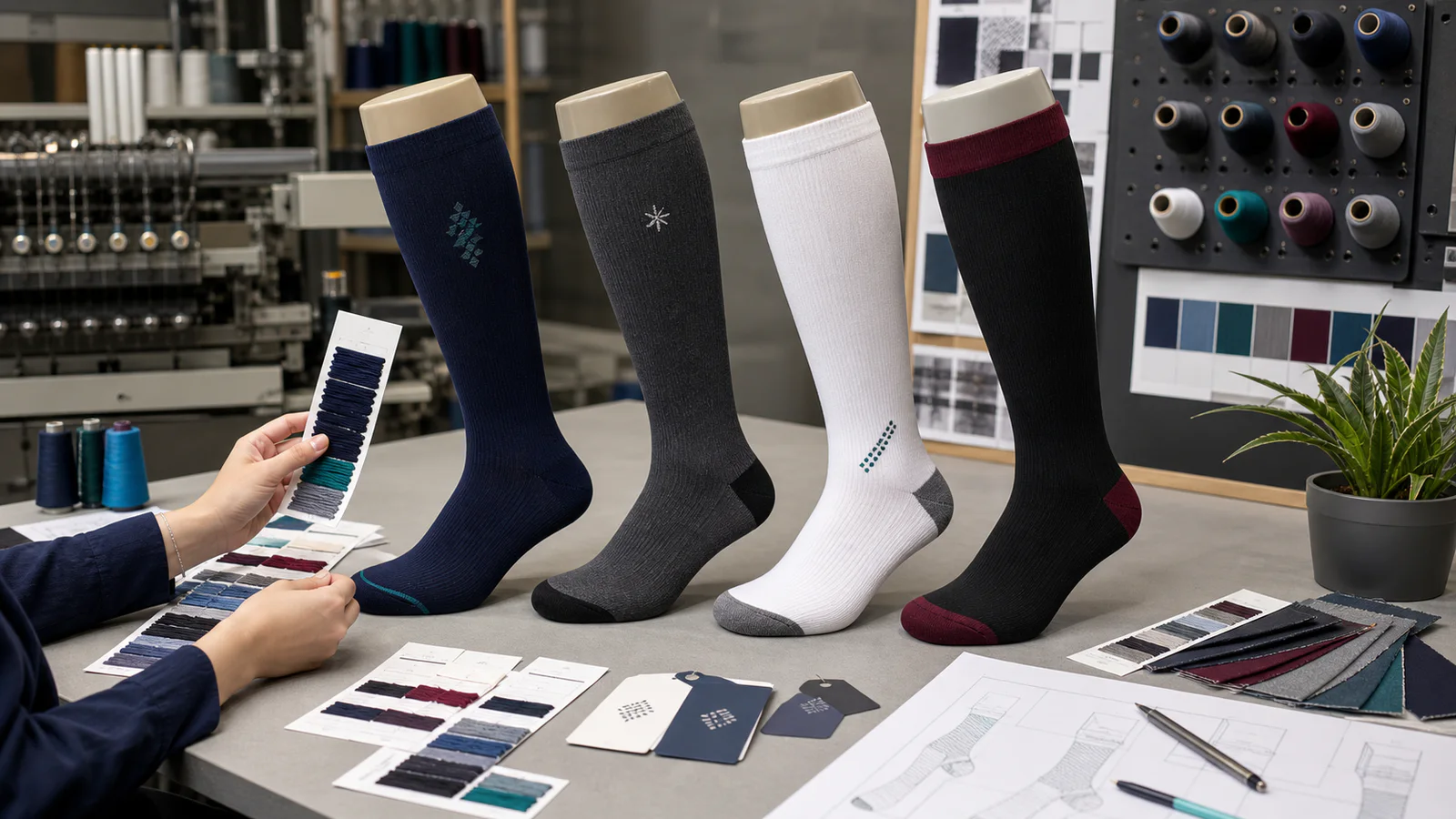
A custom compression sock logo can be integrated as a knitted motif, added as embroidery or print, or carried mainly through cuff colors and packaging. The best method depends on logo complexity, stretch, wearer comfort, placement, quantity, and wash durability. Buyers should approve the logo on the actual sock construction, not only on a flat artwork proof.
Compression socks stretch differently around the ankle, calf, and cuff. A logo that looks correct in a vector file can widen, narrow, or distort when knitted and worn. Branding decisions therefore belong in product development, not only in packaging artwork.
Compare common branding methods
| Method | Best for | Buyer checks |
|---|---|---|
| Knitted jacquard motif | Simple shapes integrated into the sock | Stretch distortion, reverse yarn floats, color contrast, comfort |
| Embroidery | Small premium mark in a lower-stretch area | Backing, stiffness, skin contact, placement consistency |
| Print or transfer | Fine detail or multiple colors where construction allows | Cracking, stretch recovery, wash resistance, hand feel |
| Cuff and packaging system | Quiet product branding with strong shelf recognition | Color consistency, band, label, insert, barcode, pack hierarchy |
Simplify artwork before sampling
Provide vector artwork, defined colors, minimum clear space, and acceptable one-color alternatives. Small text, thin strokes, gradients, and complex outlines rarely translate cleanly into knit. A simplified motif often looks more intentional and remains recognizable after the fabric stretches.
Choose placement around function
Logo placement should not interfere with pressure zones, cuff comfort, toe seams, or footwear. Common development areas include the upper calf, outer ankle, foot top, sole, or a controlled cuff detail. Review the mark both flat and on an appropriately sized leg form.
Approve color under realistic conditions
Yarn color and printed color do not behave like a screen preview. Evaluate branding next to the body yarn, heel and toe reinforcement, packaging substrate, and retail lighting. Record the approved physical sample and the agreed tolerance for bulk color variation.
Test branding with the product
A logo method must survive the same stretch, wear, and wash cycle as the sock. Include logo appearance in sample comments and bulk inspection criteria. Check edge definition, placement, puckering, loose yarn, cracking, color transfer, and whether the branded area feels different against the leg.
Buyer takeaway
Use the product as the branding canvas. Start with a simple mark, select a placement that respects compression construction, approve a physical sample, and connect the final logo specification to packaging and inspection files.
Frequently asked questions
What file should a buyer send for a compression sock logo?
Send editable vector artwork when possible, plus color references, dimensions, placement, and an approved simplified version for small-scale use.
Can a detailed logo be knitted into compression socks?
Some detail may be possible, but thin lines and small text can distort in knit. A simplified motif usually gives more consistent results across sizes and stretch.
Should logo placement be identical across every size?
The visual target should be consistent, but positioning may need size-specific grading. Approve how the mark sits on each size rather than relying on one universal distance.